← Forage Calendar mapKnow this look-alike
Wild Onion, Garlic and Ramp Look-alikes: Death Camas and Friends
These look-alikes can be deadly. Get the identification right before you eat anything. If it does not smell like onion or garlic, do not eat it. Death camas, false hellebore, and lily of the valley grow alongside wild onions, garlic, chives, and ramps and are dangerously toxic. The onion smell is the single most reliable test for the allium group.
The dangerous species
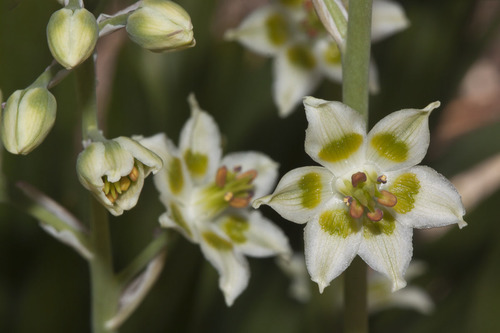
⚠ do not eatDeath Camas
Anticlea elegans (Zigadenus elegans) / Zigadenus venenosus / Anticlea glauca
marlin harms · CC BY
How to tell it apart
- The leaves are sharply folded into a 'V' shape along their length, quite unlike the leaves of wild onions. — Wikipedia ↗
- As few as two bulbs are sufficient to kill a fully-grown human, with the poisons not degraded by cooking. — Wikipedia ↗
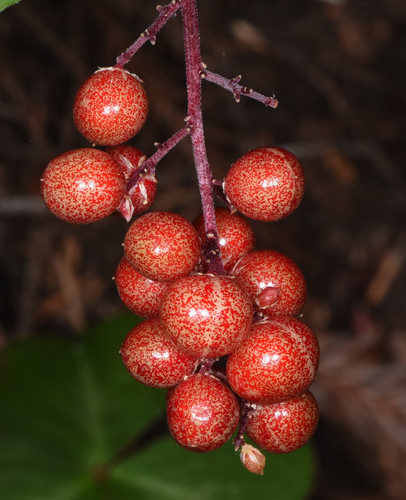
⚠ do not eatLily of the Valley
Convallaria majalis
W.carter · CC0
How to tell it apart
- This groundcover grows to a height of 10 inches and a spread of 1 to 2 feet with lush green leaves and delicate, fragrant bell shaped white flowers. — NC State Extension ↗
- Due to the high concentration of potent cardiac glycosides (cardenolides), it is highly poisonous if consumed by humans or other animals. — Wikipedia ↗
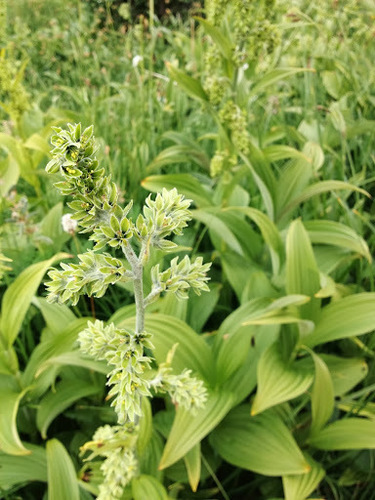
⚠ do not eatFalse Hellebore / Corn Lily
Veratrum viride (Eastern False Hellebore) / V. californicum (Western Corn Lily)
101595408250610106310 · CC BY
How to tell it apart
- The leaves are spirally arranged, 10 to 35 cm (4 to 14 in) long and 5 to 20 cm (2 to 8 in) broad, elliptic to broad lanceolate ending in a short point, heavily ribbed and hairy on the underside. — Wikipedia ↗
- The plant is highly toxic, causing nausea and vomiting. — Wikipedia ↗
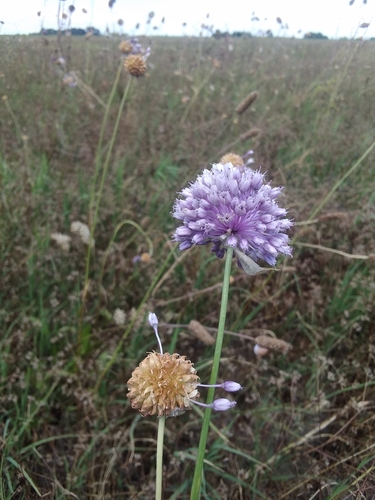
Edibles people confuse with these
If you are foraging any of these, rule out the look-alikes above every time.
The notes above are an educational starting point, not a substitute for a field guide or an experienced forager. If you are not completely certain, do not eat it.