← Forage Calendar mapKnow this look-alike
Morel Look-alikes: False Morels and Early Morels
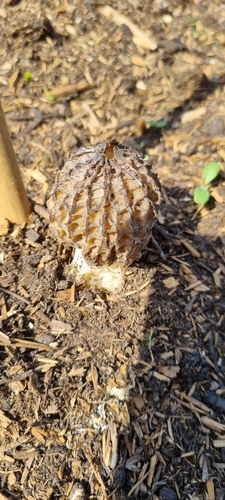
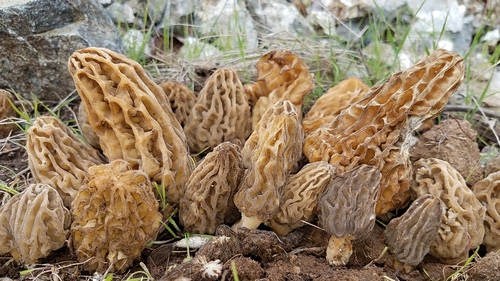
These look-alikes can be deadly. Get the identification right before you eat anything. True morels are hollow, with a pitted cap fused to the stem. The dangerous mimics are false morels (Gyromitra), whose toxin can be fatal, and the early morels (Verpa), which hang free from the stem. Slice every morel top to bottom to confirm it is hollow.
The dangerous species
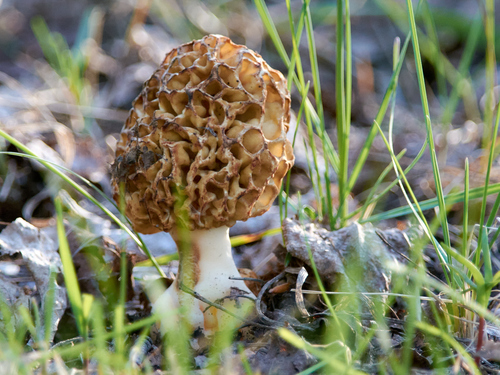
⚠ do not eatFalse Morel
Gyromitra esculenta (and related Gyromitra spp.)
Kruczy89 · CC0
How to tell it apart
- The red-brown cap is irregularly lobed, rather like a brain, and is usually broader than it is tall. — First Nature ↗
- When consumed, the principal active mycotoxin, gyromitrin, is hydrolyzed into the toxic compound monomethylhydrazine, which affects the liver, central nervous system, and sometimes the kidneys. — Wikipedia ↗
- Even after boiling, small amounts of gyromitrin and other hydrazine derivatives remain in the mushrooms. — Wikipedia ↗
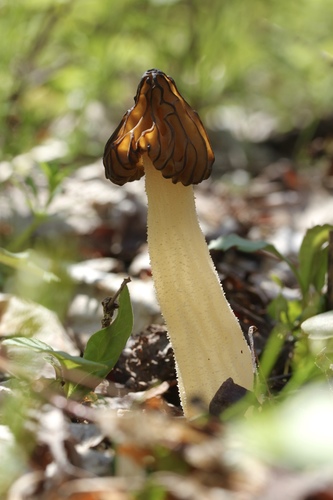
⚠ do not eatEarly Morel / Wrinkled Thimble Cap
Verpa bohemica / V. conica
Matt Bowser · CC BY 4.0
How to tell it apart
- A feature distinguishing the species from true morels (genus Morchella), the cap hangs free from the top of the stem, which is lighter in color, brittle, and up to 12 cm (4¾ in) long by 1 to 2.5 cm (⅜ to 1 in) thick. — Wikipedia ↗
- Although it is eaten by many, consumption of large amounts in a single sitting, or on successive days, has been reported to cause poisoning in susceptible individuals. — Wikipedia ↗
Edibles people confuse with these
If you are foraging any of these, rule out the look-alikes above every time.
The notes above are an educational starting point, not a substitute for a field guide or an experienced forager. If you are not completely certain, do not eat it.