← Forage Calendar mapKnow this look-alike
Puffball Look-alikes: Earthballs and Amanita Buttons
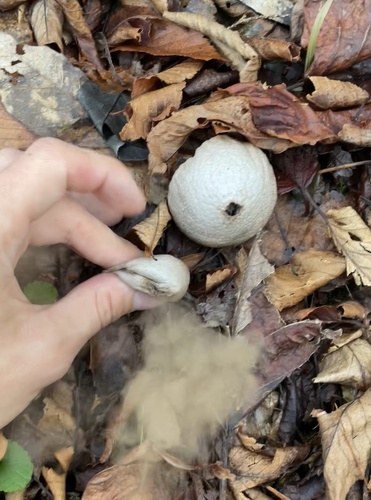
These look-alikes can make you seriously ill. Get the identification right before you eat anything. A true edible puffball is pure white and uniform inside when sliced. Earthballs have a thick rind and a firm dark interior, and an Amanita button reveals a tiny developing cap and gills inside. Always cut every puffball in half from top to bottom.
The dangerous species
⚠ do not eatCommon Earthball
Scleroderma citrinum (and related Scleroderma spp.)
Holger Krisp · CC BY 3.0
How to tell it apart
- Inside the earthball the spore mass is almost white at first but soon turns brown with white marbling before becoming purple-brown throughout. — First Nature ↗
- Ingestion of S. citrinum can cause gastrointestinal distress in humans and animals. — Wikipedia ↗
⚠ do not eatAmanita Egg Stage (Death Cap / Destroying Angel button)
Amanita phalloides / A. bisporigera / A. ocreata (immature)
George Chernilevsky · Public domain
How to tell it apart
- Make sure you cut through any puffball from top to bottom to confirm that it is pure white inside, like a marshmallow, with no sign of a cap or stem. — Missouri Department of Conservation ↗
- Young puffballs in the edible stage, before maturation of the gleba, have undifferentiated white flesh within, whereas the gills of immature Amanita mushrooms can be seen if they are closely examined. — Wikipedia ↗
Edibles people confuse with these
If you are foraging any of these, rule out the look-alikes above every time.
The notes above are an educational starting point, not a substitute for a field guide or an experienced forager. If you are not completely certain, do not eat it.